

How to Verify a Bulk Red Chilli Supplier Before Placing Your First Order
How to Verify a Bulk Red Chilli Supplier Before Placing Your First Order
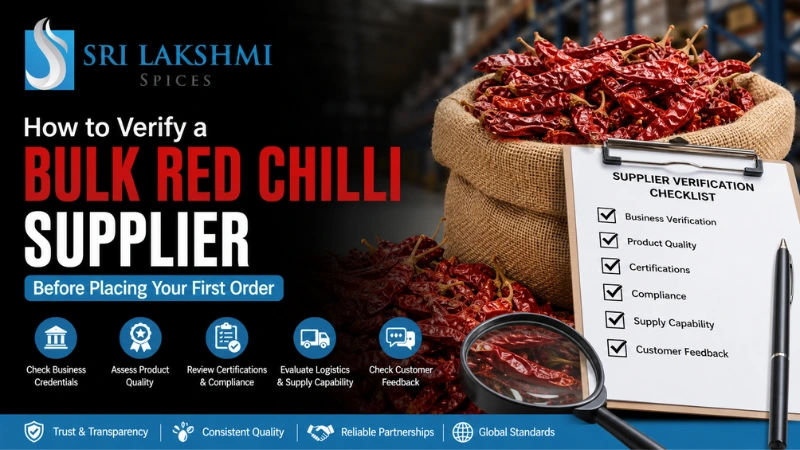
Picking the wrong supplier for your first bulk order can cost you more than money. It can damage your production schedule, hurt your product quality, and make your customers question your brand. When you are sourcing bulk supply of red chillies for food manufacturing, seasoning blending, or export, getting supplier verification right from the start is the difference between a reliable long-term partnership and an expensive lesson.
This guide walks you through every stage of the verification process - from checking paperwork to tasting the product itself - so you know exactly what to look for before signing anything.
Start with the Basics: Company Background and Trade History
Before you get into quality specs or pricing, spend time understanding who you are actually dealing with. A legitimate chilli supplier with real experience will have a traceable trade history - years of export records, established buyer relationships, and a physical processing facility you can verify.
Ask for their Import Export (IE) Code, which is mandatory for any Indian exporter. Check if they are registered with APEDA (Agricultural and Processed Food Products Export Development Authority), as this registration is a baseline requirement for any serious agricultural exporter in India.
Look them up on the Directorate General of Foreign Trade (DGFT) portal. You can verify their IEC number and get a basic picture of their export profile. If the company has no visible trade history or is reluctant to share basic registration details, that tells you what you need to know early.
Also look at how long they have been operating specifically in chillies - not just "spices" in general. A supplier with three generations of experience in Guntur chillies has a very different level of product knowledge than a trading intermediary who handles ten different commodities.
Certifications That Actually Matter in Chilli Trade
Food Safety and Quality Certifications
Certifications are not just paperwork. They tell you whether a supplier has submitted to third-party scrutiny of their production and handling practices. For any bulk spice supplier, the minimum you should expect is FSSAI registration. For export-grade material, ISO 22000 or HACCP certification signals that food safety management systems are in place.
If you are buying for the European or US market, ask specifically about pesticide residue testing reports. Chillies from India face scrutiny at international ports over MRL (Maximum Residue Limit) violations, and a serious supplier will have recent lab reports ready to share without hesitation.
Aflatoxin Testing and Heavy Metal Reports
This is non-negotiable for bulk supply of chilli powder, where mold contamination risk is highest due to grinding and storage conditions. Ask for COA (Certificate of Analysis) from an accredited third-party lab, not just an in-house test. The report should cover aflatoxin B1, B2, G1, G2 levels, as well as moisture content, ash content, and ASTA color value for powder.
For whole chillies, check moisture content closely. Anything above 12% creates a mold risk during transit and storage, especially in humid shipping conditions.
Request Samples Before Committing to Any Volume
No serious buyer should skip this step, and no serious supplier will object to it. When you reach out for samples of their bulk supply of red chillies, pay attention to how quickly and professionally they respond. A supplier who takes two weeks to send a sample and provides no documentation with it is already showing you their operational standards.
When the sample arrives, check the following without any compromise:
The color should be consistent and vivid - dull or faded chillies indicate poor drying, old stock, or improper storage. Break a few open and check the seeds - discoloration inside suggests moisture damage. Smell the sample immediately upon opening. Fresh dried chillies have a sharp, characteristic pungency. A musty or flat smell is a red flag.
For chilli flakes, check the uniformity of the crush, the seed-to-flesh ratio, and whether the flakes are free of stems and foreign matter. For powder, rub a small amount between your fingers. The color should stain and the texture should be fine and consistent, not coarse or gritty.
Send the sample to your own lab for an independent COA verification. This adds a week to your process but protects you from accepting substandard material that came with impressive-looking supplier documentation.
Evaluate the Processing and Storage Facility
A supplier's facility quality directly determines the quality of what ends up in your order. If you are placing a significant first order, ask for a virtual or in-person facility visit. Reputable Guntur-based exporters will not hesitate - they know their infrastructure is a selling point.
Look for a dedicated processing unit separate from raw material storage. The area should be clean, enclosed, and pest-controlled. Chillies that are processed in open yards or stored without proper covering are exposed to contamination risks that no certification can fully eliminate.
Check if they have their own godown (warehouse) or if they operate from rented spaces. Suppliers with their own infrastructure have more control over stock quality, can maintain consistent supply even during off-season, and are generally more reliable on delivery commitments.
Ask about their bulk supply of chilli flakes processing line specifically - whether crushing and sieving happen in a hygienic enclosed environment, and whether the equipment is cleaned between batches when different chilli varieties or grades are processed.
Understand Their Pricing Structure and Payment Terms
A supplier quoting prices significantly below the prevailing Guntur market rate is either cutting corners on quality, substituting inferior varieties, or giving you a bait price that will change at the time of actual order. Get pricing transparency from the start.
Ask for an ex-factory price, CIF price (if they handle shipping), and a clear breakdown of what the per-kg or per-MT rate includes - grade of chilli, moisture level, packing type, and documentation. Vague pricing with too many "depends on" conditions is a sign of either inexperience or intentional ambiguity.
On payment terms, most established Indian chilli exporters work on a 30% advance and 70% against documents or LC (Letter of Credit) arrangement for first-time buyers. If a supplier demands 100% advance from a new buyer with no escrow or security arrangement, be cautious. Equally, if they offer extended credit with no verification of your own business, that should also raise questions.
Check References and Buyer Reviews
This step gets skipped too often. Ask the supplier directly for two or three existing buyer references - companies who have been ordering from them for at least a year. A confident supplier with real client relationships will connect you. A hesitant supplier who gives you vague answers is protecting something.
When you speak to existing buyers, ask specific questions: Did the shipment arrive on time? Was the quality consistent with the sample? How did the supplier handle issues when they came up? The answers to that last question are often the most revealing.
Also look at their export data through platforms like Volza or Zauba. These aggregators pull from Indian customs data and show you exactly which countries and companies a supplier has shipped to, in what volumes, and how frequently. If a supplier claims to be a major exporter but has sparse or irregular shipment data, the claim does not hold up.
Place a Trial Order Before Scaling Up
Even after all due diligence, your first actual order should be a controlled trial - not your full seasonal requirement. A trial order of one or two MT lets you verify everything in real conditions: packing quality, transit handling, documentation accuracy, and whether the commercial sample matches the pre-shipment sample.
The bulk supply of red chillies that arrives at your warehouse should match the COA, the pre-shipment sample, and the agreed specifications exactly. Any deviation - in moisture, color, grade, or weight - should be raised immediately and documented. How a supplier handles a discrepancy on a small trial order tells you more about their reliability than any certification ever will.
Once a supplier passes this end-to-end test, you have a foundation for scaling volume with confidence. Document every step - the samples, the COA reports, the communication trail, the delivery performance - and use that record to build your standard operating procedure for supplier onboarding going forward. This creates accountability on both sides and removes ambiguity from future orders.
What You Take Away from This
Supplier verification is not a formality to get through - it is the actual work of building a supply chain that won't let you down. The exporters worth working with understand this and will walk through every step of this process with you without resistance. They know that a buyer who asks hard questions upfront is a buyer who stays long-term.
If a supplier makes any part of this process feel difficult or unreasonable, that friction is the answer you were looking for. The right partner for your bulk spice sourcing should make you feel more confident after every conversation, not less.