

Bulk Chilli Powder & Chilli Flakes Supply from India: The Complete B2B Sourcing Guide
Bulk Chilli Powder & Chilli Flakes Supply from India: The Complete B2B Sourcing Guide
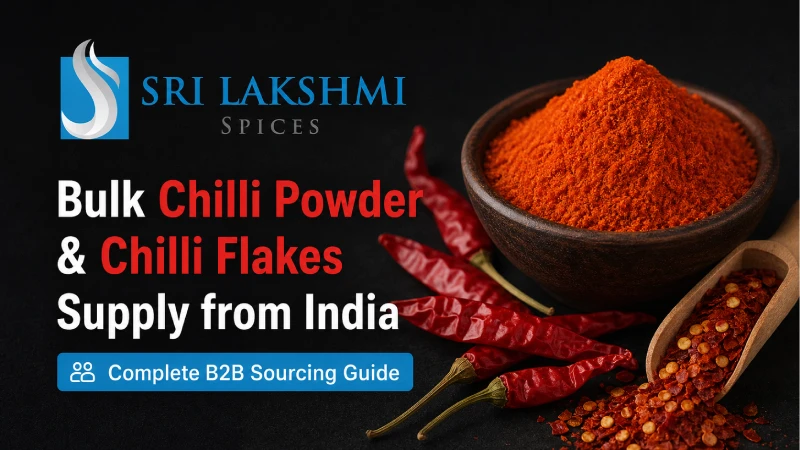
If your business needs a bulk supply of chilli powder or a bulk supply of chilli flakes for food manufacturing, food service, retail private labelling, or industrial seasoning applications, India is the world's largest producer and exporter of chilli, and sourcing directly from Indian processors is typically the most cost-effective and quality-consistent route. This guide walks procurement managers, import buyers, and food industry sourcing teams through everything needed to evaluate, specify, and place a bulk supply of red chillies, ground chilli powder, or chilli flake order - including specifications, pricing, quality standards, and how to vet red chilli powder suppliers India and red chilli flakes suppliers India before signing a contract.
This is a long, detailed reference document. Use the table of contents to jump to what you need, or read start to finish if you're building a sourcing strategy from scratch.
A bulk supply of chilli powder is a commercial-scale, contract-based procurement arrangement - typically 1 metric ton or more per order - in which a manufacturer, distributor, or food brand sources ground red chilli, chilli flakes, or whole red chillies directly from processors or exporters, usually in India, under agreed specifications for heat level, color, moisture, and food-safety compliance.
India accounts for a large share of the world's chilli production and export volume, drawing on growing regions such as Guntur (Andhra Pradesh), Byadgi (Karnataka), Mathania (Rajasthan), and parts of Madhya Pradesh and Telangana. For procurement teams - whether you run a spice blending unit, a snack food factory, a QSR chain's central kitchen, or a private-label retail brand - the difference between a good and a poor bulk sourcing decision shows up in three places: consistency of heat and color batch to batch, food-safety compliance at the border, and total landed cost.
This guide is written from an industry-practitioner perspective - covering not just "what chilli powder is," but the operational realities of specifying, testing, negotiating, and receiving a bulk shipment.
Quick Facts Box
- India is the world's largest producer, consumer, and exporter of chilli (dried chilli, chilli powder, and chilli-based products).
- Guntur (Andhra Pradesh) is India's largest chilli trading hub, home to the Guntur Mirchi Yard, one of Asia's largest chilli markets.
- Standard export packaging for bulk chilli powder is 25 kg multi-layer paper/PP bags with an internal food-grade liner, or 20–25 kg cartons for premium grades.
- Typical bulk order MOQs range from 1 MT (LCL) to a full container load of 16–20 MT (FCL).
What Is Bulk Chilli Powder?
Bulk chilli powder is dried red chilli (Capsicum annuum or related species) that has been cleaned, deseeded or partially deseeded, and mechanically ground into a fine powder, then packed and sold in large quantities (typically 25 kg bags upward) for industrial, food-service, or wholesale distribution use, rather than small retail packs.
In plain terms: it's the same red chilli powder used in home kitchens, but processed, tested, and packaged to commercial specifications - consistent particle size, verified heat level, controlled moisture, and documentation that satisfies import food-safety authorities. Bulk chilli flakes are the coarser, cracked version of the same dried chilli, used where visible flake texture and burst pungency matter more than fine powder dispersion (pizza toppings, marinades, snack seasoning).
Kuttimirch is a regional/Hindi-Telugu term literally meaning "pounded chilli" - a coarsely crushed red chilli product that sits between whole dried chilli and fine powder in texture. Buyers searching for kuttimirch manufacturers are typically looking for this coarse-crushed format, distinct from fine powder and from uniform-cut flakes.
Key Features of Commercial-Grade Chilli Powder & Flakes
Commercial-grade bulk chilli powder and flakes are defined by five measurable features: heat level (Scoville Heat Units), color value (ASTA units), moisture content (≤10-11%), particle/mesh size consistency, and freedom from extraneous matter, pesticide residues, and microbial contamination - all verifiable through lab test reports (CoA).
- Pungency (Heat): Measured in Scoville Heat Units (SHU) or capsaicin percentage. Ranges from mild (Kashmiri chilli, ~2,000–5,000 SHU) to extra hot (Guntur Sannam, 35,000–45,000+ SHU).
- Color:Measured in ASTA units (American Spice Trade Association color scale). Higher ASTA = deeper red. Byadgi chilli is prized for high color, low heat.
- Moisture Content: Typically specified at 8–11% max. Higher moisture risks mold and clumping in transit.
- Granulation / Mesh Size: Fine powder (40–80 mesh), coarse/kuttimirch (8–20 mesh), flakes (custom cut, often 3–5mm with or without seeds).
- Extraneous Matter: Stem content, foreign material, and insect fragments must be within Codex/FSSAI/FDA-permitted limits.
- Microbiological Safety: Salmonella-negative, E. coli within limits, low total plate count - critical for ready-to-eat and export-grade product.
- Non-Irradiated / Steam-Sterilized Options: Many Western buyers require steam sterilization instead of ethylene oxide (EtO) or irradiation, per EU and increasingly US regulatory trends.
Benefits of Sourcing Bulk Chilli Powder from India
Sourcing a bulk supply of chilli powder from India gives buyers access to the world's largest chilli-growing base, competitive FOB pricing due to scale production, wide varietal choice (heat/color combinations unavailable elsewhere), established export infrastructure (APEDA/Spice Board), and manufacturers experienced in meeting FSSAI, ISO 22000, HACCP, and international buyer specifications.
- Scale and price competitiveness India's chilli-growing area and output volume support large, stable supply even during global shortages elsewhere.
- Varietal depth- from ultra-mild Kashmiri (color-forward) to fiery Guntur Sannam (heat-forward), buyers can specify exact SHU/ASTA combinations rather than accepting a single generic "red chilli powder."
- Established export ecosystem Spice Board of India registration, APEDA certification pathways, and container-load logistics from major ports (Chennai, Kochi, Mundra, Nhava Sheva) are mature and well-documented.
- Custom processing capability many processors offer custom grinding (mesh size), custom blends (e.g., 80% chilli powder + 20% paprika for color adjustment), and private-label packaging.
- Traceability options increasingly, exporters can provide farm-to-batch traceability, important for buyers with sustainability or supply-chain-transparency requirements.
Types & Categories of Chilli Powder and Chilli Flakes
Bulk chilli products fall into four main categories: fine chilli powder (ground, for seasoning and blending), chilli flakes (cracked/cut, for topping and visual texture), kuttimirch/coarse crushed chilli (mid-texture, for regional cuisine and pickling), and whole dried red chillies (unprocessed, for in-house grinding or oleoresin extraction).
| Category | Description | Typical Mesh/Size | Common Use |
|---|---|---|---|
| Fine Chilli Powder | Finely ground, uniform | 40–80 mesh | Curry powders, spice blends, sauces |
| Kuttimirch (Coarse Crushed) | Pounded/cracked, irregular | 8–20 mesh | Regional cooking, pickles, tempering |
| Chilli Flakes | Cut/cracked, deseeded or with seed | 3–5mm flakes | Pizza, pasta, snack seasoning |
| Whole Dried Red Chilli | Unground pods | N/A | In-house grinding, oleoresin extraction |
By Variety (India-Specific)
- Guntur Sannam (S4/S17): High heat (~30,000–40,000 SHU), moderate color - the workhorse export variety.
- Byadgi:Low heat, exceptionally high color (deep red) - used where color matters more than pungency.
- Kashmiri Chilli: Very mild, brilliant red color - popular for color-forward applications.
- Teja (S17/S4 hybrid):Very high heat, used in extra-hot formulations and oleoresin extraction.
- Mathania (Rajasthan):Aromatic, medium heat, regionally prized.
If your product needs deep red color without excessive heat (e.g., a mild sauce or a color-forward seasoning blend), specify a Byadgi-Guntur blend rather than a single variety - this is standard practice among experienced Indian processors and gives more consistent batch-to-batch color than relying on one varietal crop.
Applications & Use Cases
Bulk chilli powder and flakes are used across food manufacturing (spice blends, sauces, snacks), food service (QSR seasoning, restaurant kitchens), meat and pickle processing, and non-food industrial applications (oleoresin/pigment extraction for pharmaceuticals and cosmetics).
- Food Manufacturing:Masala/spice blend production, instant noodle seasoning, sauce and ketchup manufacturing, ready-to-eat meal seasoning.
- Food Service / QSR: Bulk seasoning shakers, marinade bases, sauce kitchens for restaurant chains.
- Snack Food Industry: Chip and namkeen seasoning, popcorn seasoning, extruded snack coating.
- Meat & Processed Food: Sausage and cured meat seasoning, marinades.
- Pickle & Preserve Manufacturing: Kuttimirch is especially favored here for its texture and flavor release.
- Pharma & Cosmetics: Oleoresin capsicum (extracted from bulk chilli) used in topical pain-relief products and, in regulated concentrations, cosmetic formulations.
- Export/Repacking/Private Label:Distributors buying bulk to repack under their own retail brand.
Buying Guide for Bulk Chilli Powder & Flakes
To buy bulk chilli powder or chilli flakes correctly, define your required SHU and ASTA color range first, confirm moisture and mesh specifications, request a Certificate of Analysis and pre-shipment sample, verify the supplier's FSSAI/Spice Board/ISO certifications, agree on Incoterms (FOB/CIF), and always test a sample batch before committing to a full container order.
Step-by-Step Buying Process
- 1. Define your specification - SHU range, ASTA color, moisture %, mesh size, whole/broken ratio for flakes, seed content.
- 2. Determine order volume - sample order, LCL (less than container load), or FCL (full container load, ~16–20 MT).
- 3. Shortlist suppliers - via Spice Board of India exporter directory, trade platforms, or direct referrals.
- 4. Request documentation- FSSAI license, Spice Board registration/RCMC, ISO 22000/HACCP certificate, past export references.
- 5. Request a pre-shipment sample - test independently for SHU, ASTA, moisture, pesticide residue, and microbiology.
- 6. Negotiate terms - pricing (FOB/CIF), payment terms (LC, TT advance/balance), lead time, packaging spec.
- 7. Confirm QC protocol - third-party inspection (SGS, Intertek, Bureau Veritas) before shipment.
- 8. Place trial order - start with a smaller volume before scaling to full container commitments.
- 9. Review Certificate of Analysis (CoA) at shipment - match against agreed spec before final payment release.
- 10. Establish a repeat-order SLA - lock in specs, lead times, and pricing review periods for ongoing supply.
Technical Specifications
Standard technical specifications requested in a bulk chilli powder or flakes purchase order include: SHU/pungency range, ASTA color value, moisture content (%), total ash and acid-insoluble ash, extraneous matter (%), particle/mesh size, microbiological limits (Salmonella, E. coli, yeast/mold), and pesticide residue compliance (EU MRL or Codex).
| Parameter | Typical Specification Range |
|---|---|
| Moisture | 8–11% max |
| ASTA Color Value | 40–120+ (variety dependent) |
| Pungency (SHU) | 0 (paprika-style) to 50,000+ |
| Total Ash | ≤7–8% |
| Acid Insoluble Ash | ≤1.3–1.5% |
| Extraneous Matter | ≤1% (max, per Codex/FSSAI) |
| Mesh Size (fine powder) | 40–80 mesh |
| Bulk Density | 0.4–0.5 g/cc (approx., varies by grind) |
| Aflatoxin | ≤5 ppb (EU), ≤20 ppb (US, varies by product type) |
| Pesticide Residue | Per EU MRL / Codex Alimentarius / destination country norms |
| Salmonella | Absent in 25g |
Always request the CoA to be issued by an accredited third-party lab (not solely the exporter's in-house lab) for the pesticide residue and microbiology parameters - this is standard practice for buyers importing into the EU, US, Japan, and other markets with strict MRL enforcement.
Raw Material Sourcing (Red Chillies)
A bulk supply of red chillies for powder and flake production is sourced from India's major chilli-growing belts - primarily Andhra Pradesh (Guntur), Karnataka (Byadgi), Telangana, Madhya Pradesh, and Rajasthan - harvested seasonally between February and May, sun-dried or mechanically dried, then routed through regulated mandis (trading yards) before processing.
Understanding raw material origin matters because it directly determines the final product's SHU, color, and consistency. Reputable processors maintain relationships with specific mandis or contract farmers to guarantee variety purity - an important distinction, since mixed-variety lots (common in unregulated trading) produce inconsistent batches that fail spec on re-test.
- Guntur Mirchi Yard (Andhra Pradesh): One of Asia's largest chilli trading markets; primary source for Sannam/Teja varieties.
- Byadgi (Karnataka):Specialized market for the Byadgi variety, prized for color.
- Mathania (Rajasthan):Known for aromatic, medium-heat chillies used in regional and export blends.
- Khammam & Warangal (Telangana): Growing hubs supplementing Andhra Pradesh's output.
Manufacturing Process
Commercial chilli powder manufacturing follows a defined sequence: raw chilli procurement and cleaning, stem removal, sun or mechanical drying to target moisture, sorting/grading, grinding (or cutting for flakes), sieving to mesh spec, metal detection, quality testing, and food-grade bulk packaging - typically completed within a controlled facility under HACCP protocols.
Manufacturing Process Flow (Numbered)
- 1. Procurement:Whole dried red chillies sourced from mandis or contract farms.
- 2. Cleaning & Sorting: Removal of stems, stalks, and foreign material; grading by size/color.
- 3. De-stemming: Mechanical stem removal (critical for extraneous matter compliance).
- 4. Drying (if required): Further mechanical drying to reach target moisture (8–11%).
- 5. Pre-grinding Inspection: Visual and metal-detector screening.
- 6. Grinding / Cutting: Fine powder via hammer mills; flakes via specialized cutting/cracking equipment; kuttimirch via coarse pounding/crushing mills.
- 7. Sieving: Sorting to target mesh size, removing over/undersized particles.
- 8. Sterilization (optional but increasingly standard): Steam sterilization to reduce microbial load without chemical residues.
- 9. Quality Testing: In-house and third-party lab testing against CoA parameters.
- 10. Packaging: Bulk bagging (25 kg multi-ply bags with liners) or drum/carton packing for premium grades.
- 11. Palletization & Documentation: Preparation of shipping documents, phytosanitary certificate, and CoA for export.
Quality Standards & Industry Certifications
Legitimate bulk chilli powder and flakes suppliers in India typically hold FSSAI licensing (mandatory for food business operators), Spice Board of India registration (RCMC - Registration-Cum-Membership Certificate, required for export), and voluntary certifications such as ISO 22000, HACCP, and sometimes BRC/FSSC 22000 for buyers with stricter global food-safety audit requirements.
- FSSAI License: Mandatory Indian food safety license for any food processing/export business.
- Spice Board of India RCMC: Required registration for any company exporting spices from India.
- ISO 22000: Food safety management systems certification.
- HACCP: Hazard Analysis and Critical Control Points - process-level food safety control.
- FSSC 22000 / BRCGS: Higher-tier global food safety certifications often required by large multinational buyers (retail chains, major food brands).
- APEDA Registration: Relevant for agricultural export documentation and incentive schemes.
- Codex Alimentarius Compliance: International reference standard for spice quality parameters.
- Organic Certification (optional): NPOP (India) / USDA Organic / EU Organic, for buyers requiring certified-organic chilli products.
Myths vs Facts
- Myth:
- Fact
- Myth:
- Fact
"Any exporter with an IEC (Import Export Code) is a legitimate spice exporter."
An IEC alone only permits import/export transactions; it does not confirm food-safety compliance. Always verify FSSAI licensing and Spice Board RCMC separately.
"Higher SHU always means better quality."
Heat level is a specification choice, not a quality indicator. A mild Kashmiri or Byadgi chilli meeting its own spec is just as "high quality" as a fiery Teja meeting its spec - quality is about consistency and compliance, not pungency alone.
Comparison Tables
The key comparison points for bulk chilli sourcing are product form (powder vs flakes vs kuttimirch vs whole), variety (Guntur vs Byadgi vs Kashmiri vs Teja), and packaging format - each suited to different downstream applications and shelf-life/handling needs.
Chilli Powder vs Chilli Flakes vs Kuttimirch
| Feature | Chilli Powder | Chilli Flakes | Kuttimirch |
|---|---|---|---|
| Texture | Fine, smooth | Cut/cracked flakes | Coarse, irregular crush |
| Visual appeal in final product | Low (blends in) | High (visible topping) | Medium |
| Best for | Blends, sauces, curries | Toppings, marinades | Pickles, regional dishes |
| Typical mesh | 40–80 | Custom flake cut | 8–20 |
| Flavor release speed | Fast | Slower, burst-release | Medium |
Variety Comparison
| Variety | Heat (SHU) | Color (ASTA) | Best For |
|---|---|---|---|
| Guntur Sannam | 30,000–40,000 | Medium | General-purpose heat |
| Byadgi | 2,000–5,000 | Very high | Color-forward products |
| Kashmiri | 1,000–2,000 | High | Mild, color-forward dishes |
| Teja | 50,000–75,000 | Medium-low | Extra-hot formulations, oleoresin |
Advantages vs Disadvantages
Sourcing bulk chilli powder directly from India offers cost and varietal advantages but comes with trade-offs around longer lead times, container logistics complexity, and the need for rigorous supplier vetting compared to buying pre-packed retail brands locally.
Advantages
- Lower per-kg cost at true bulk volumes (FCL orders)
- Wide varietal and custom-blend availability
- Direct relationship with processor enables spec customization
- Access to fresh-season crop with better SHU/color consistency
Disadvantages
- Longer lead times (typically 3–8 weeks door-to-door depending on Incoterms and destination)
- Import compliance burden (pesticide MRL, phytosanitary, labeling) sits partly with the buyer
- Requires container-level MOQ for best pricing (smaller buyers face higher per-unit cost)
- Quality variability risk if supplier vetting is skipped
Receiving, Storage & Installation Guide
On arrival, bulk chilli powder or flakes should be inspected for bag integrity and off-odors, stored in a cool (below 25°C), dry (relative humidity below 60%), dark environment away from direct sunlight and moisture sources, and rotated on a first-in-first-out (FIFO) basis to preserve color and pungency.
Step-by-Step Receiving Protocol
- Inspect container/truck seal number against shipping documents before unloading.
- Check bags for tears, moisture staining, or pest evidence.
- Pull a receiving sample and compare color/aroma against the approved pre-shipment sample.
- Verify batch/lot numbers match the CoA.
- Move to climate-controlled dry storage within 24 hours of unloading.
- Log received lot into inventory system with expiry/best-before tracking.
Storage Best Practices
- Store on pallets, off the floor, with airflow space between stacks.
- Maintain warehouse humidity below 60% RH to prevent caking and mold risk.
- Avoid storage near strong-odor products (spice powder readily absorbs ambient odors).
- Keep away from direct sunlight to preserve ASTA color value over time.
Maintenance & Inventory Guide
Ongoing "maintenance" of bulk chilli powder inventory means active shelf-life management: FIFO stock rotation, periodic re-testing of color and moisture for long-held lots, resealing opened bulk bags with liners, and monitoring for clumping or color fade as early indicators of quality degradation.
- FIFO Rotation: Always issue oldest verified-quality stock first.
- Periodic Re-Testing: For lots held longer than 4–6 months, re-check moisture and ASTA color before production use.
- Reseal Practices: Once a bulk bag is opened, reseal with the internal liner and store in a sealed secondary container to limit oxygen and moisture exposure.
- Pest Monitoring: Regular warehouse pest control checks - dried spice is susceptible to weevil and moth infestation if storage conditions lapse.
- Shelf Life: Properly stored bulk chilli powder typically holds specification for 12 months; flakes and kuttimirch may hold slightly longer due to lower surface area exposure.
Common Problems & Troubleshooting
The most common problems in bulk chilli powder sourcing are batch-to-batch color/heat inconsistency, moisture-related clumping, failed pesticide residue tests at the border, and mismatched mesh size - most of which are prevented through pre-shipment sample testing and clearly documented specifications in the purchase order.
| Problem | Likely Cause | Fix / Prevention |
|---|---|---|
| Color inconsistency batch to batch | Mixed variety sourcing, non-standardized blending | Specify single-origin variety or fixed blend ratio in PO; request ASTA test per batch |
| Clumping / caking | Moisture above spec, poor storage | Verify moisture at receiving; store below 60% RH |
| Pesticide residue failure at customs | Unverified farm sourcing, no MRL testing pre-shipment | Require third-party pesticide residue CoA before shipment |
| Off-aroma / musty smell | Mold growth from excess moisture or old stock | Reject lot; audit supplier's drying and storage process |
| Inconsistent flake size | Manual/inconsistent cutting process | Request mechanically calibrated flake-cutting equipment; ask for sieve analysis report |
| Higher-than-quoted extraneous matter | Inadequate cleaning/de-stemming | Specify max extraneous matter % in contract; inspect sample |
Pricing Factors
Bulk chilli powder and flake pricing is driven primarily by variety and SHU/ASTA specification, current crop-year harvest volume, order volume (FCL vs LCL pricing tiers), processing level (whole vs powder vs custom blend), packaging format, and Incoterms (FOB vs CIF vs DDP).
- Variety & Specification: Higher-color (Byadgi) and higher-heat (Teja) varieties often command premium pricing over standard Sannam grades.
- Crop Year & Harvest Volume: Chilli is an agricultural commodity - pricing fluctuates with annual yield, weather impact, and carryover stock.
- Order Volume: FCL pricing is meaningfully lower per kg than LCL or sample-volume pricing.
- Processing Level: Custom fine grinding, deseeding, or blending adds processing cost versus standard powder.
- Packaging: Premium retail-ready packaging costs more than standard 25kg export bags.
- Incoterms: FOB (buyer arranges freight) is typically cheaper on paper than CIF or DDP (seller-inclusive freight/insurance/duty) but shifts logistics coordination burden to the buyer.
- Currency & Freight Market: INR/USD exchange rates and ocean freight rate cycles materially affect landed cost.
Always request pricing broken down as (a) ex-factory/FOB unit price, (b) freight, (c) insurance, and (d) any documentation/inspection fees separately - bundled CIF quotes make it hard to benchmark supplier competitiveness on the actual product cost.
Supplier/Vendor Selection Guide
Selecting a reliable bulk chilli powder or flakes supplier in India requires verifying FSSAI license and Spice Board RCMC registration, checking export track record and existing international buyer references, requesting and independently testing a pre-shipment sample, confirming lab testing capability (in-house or via accredited third party), and starting with a trial order before scaling to full-container commitments.
Supplier Vetting Checklist
- Valid FSSAI license (verify registration number)
- Spice Board of India RCMC registration
- ISO 22000 / HACCP certification (request copies)
- Minimum 2–3 verifiable export references or trade history
- In-house or accredited third-party lab testing capability
- Willingness to provide pre-shipment sample for independent testing
- Clear, itemized quotation (FOB breakdown, not just bundled CIF)
- Defined QC protocol and CoA issuance process
- Transparent lead time and logistics communication
- Positive response to a trial/sample order before FCL commitment
For first-time buyers, engaging a third-party inspection agency (SGS, Intertek, Bureau Veritas, or a Spice Board-empanelled inspector) for pre-shipment inspection is a small cost relative to the risk of a rejected or off-spec container arriving at a foreign port.
Industry Trends & Future Outlook
Key trends shaping the bulk chilli powder and flakes trade include rising demand for steam-sterilized (non-EtO, non-irradiated) processing to meet EU/US regulatory shifts, growing interest in traceable/farm-linked sourcing, increased demand for custom private-label blends, and tightening pesticide MRL enforcement pushing buyers toward more rigorously tested suppliers.
- Sterilization Method Shift: Global buyers increasingly require steam sterilization over ethylene oxide treatment, driven by regulatory tightening in the EU and growing scrutiny in the US.
- Traceability Demand: Larger food brands are asking for farm-to-batch traceability documentation as part of supply-chain transparency and sustainability reporting.
- Custom Blending & Private Label Growth: More buyers are requesting custom SHU/ASTA blends and their own retail-ready packaging rather than generic bulk product.
- Stricter MRL Enforcement: Pesticide residue limits are being enforced more strictly at ports of entry, raising the bar for pre-shipment testing rigor.
- Climate Variability Impact: Weather-driven yield fluctuations in Indian growing regions are prompting buyers to diversify supplier relationships across multiple growing belts rather than relying on a single region.
Case Studies / Real-World Examples
Typical real-world bulk chilli sourcing scenarios include a snack food manufacturer switching to a Byadgi-Guntur blend to solve color-consistency complaints, and a QSR chain establishing a dual-supplier strategy across two growing regions to protect against seasonal supply disruption.
- Color Consistency Fix (Snack Manufacturer): A mid-sized snack seasoning manufacturer was experiencing customer complaints about inconsistent seasoning color across production batches. Root-cause investigation traced the issue to their supplier sourcing mixed-variety chilli lots without fixed blend ratios. The fix: moving to a supplier offering a fixed 70:30 Guntur-to-Byadgi blend ratio, locked into the purchase specification, with ASTA testing on every batch. Result: batch-to-batch color variance dropped significantly within two production cycles.
- Supply Continuity (QSR Central Kitchen): A regional QSR chain's central kitchen relied on a single Andhra Pradesh-based supplier for its chilli flake requirement. A regional weather event affected one season's harvest, creating a short-term supply gap. The chain subsequently adopted a dual-region supplier strategy - maintaining a secondary qualified supplier sourcing from a different growing belt - to de-risk future seasonal disruptions without renegotiating specs from scratch.
Frequently Asked Questions
What is the minimum order quantity (MOQ) for a bulk supply of chilli powder from India?
MOQs vary by supplier, but most Indian exporters set a minimum of 1 metric ton for LCL (less than container load) orders, with full container loads (FCL) typically ranging from 16–20 metric tons for better per-unit pricing.
What is the difference between chilli powder and chilli flakes in bulk sourcing?
Chilli powder is finely ground for blending into sauces, curries, and dry mixes, while chilli flakes are cut or cracked pieces retaining visible texture, commonly used as a topping on pizza, pasta, or snacks. Flakes generally have slower flavor release and stronger visual appeal.
What documentation should a legitimate red chilli powder supplier in India provide?
A legitimate supplier should provide an FSSAI license number, Spice Board of India RCMC registration, a Certificate of Analysis (CoA) for each batch, and - for export orders - a phytosanitary certificate and, where required, a certificate of origin.
How is chilli heat level measured for bulk orders?
Heat is measured in Scoville Heat Units (SHU), either through the traditional organoleptic Scoville test or, more commonly today, HPLC-based capsaicin quantification, which is faster and more precise for commercial specification purposes.
What is kuttimirch and how is it different from regular chilli powder?
Kuttimirch is a coarsely pounded or crushed red chilli product, coarser than chilli flakes and much coarser than fine powder. It's commonly used in pickling and certain regional dishes where a chunkier texture and slower flavor release are desired. Buyers looking for kuttimirch manufacturers should specify the desired mesh/particle size clearly, as "kuttimirch" texture can vary between suppliers.
What is the typical shelf life of bulk chilli powder and flakes?
Under proper storage conditions (cool, dry, below 60% relative humidity, away from direct sunlight), bulk chilli powder typically retains its specification for around 12 months, with flakes and kuttimirch often holding slightly longer due to lower surface area exposure.
Can bulk chilli powder be customized in terms of heat level and color?
Yes. Reputable processors can produce custom blends by combining varieties (e.g., Guntur for heat, Byadgi for color) to hit a specific target SHU and ASTA range, which should be documented clearly in the purchase specification and verified via CoA.
What packaging is standard for bulk chilli powder export?
Standard export packaging is 25 kg multi-ply paper or PP bags with a food-grade internal liner, though premium or private-label orders may use drums, cartons, or custom retail-ready packaging depending on buyer requirements.
How do I verify a supplier's quality claims before placing a large order?
Request a pre-shipment sample and have it independently tested (not solely relying on the supplier's in-house CoA) for SHU, ASTA color, moisture, pesticide residue, and microbiological safety, and consider engaging a third-party inspection agency for a pre-shipment audit before full payment release.
What are the main cost components in the landed price of bulk chilli powder?
The landed cost typically includes the ex-factory/FOB product price, ocean freight, marine insurance, import duty/tariffs (destination-country dependent), port handling and customs clearance fees, and inland transportation to the buyer's warehouse.
A successful bulk supply of chilli powder or bulk supply of chilli flakes arrangement comes down to three fundamentals: a clearly documented technical specification, a properly vetted supplier with verifiable food-safety compliance, and an independent testing step before full-container commitment. India's scale, varietal range, and mature export infrastructure make it the natural sourcing base for most global buyers - but the advantages only materialize when the buying process is disciplined. Whether you're sourcing fine powder for a spice blending line, flakes for a food-service seasoning program, or kuttimirch for a pickle production run, the same core due-diligence steps apply: define the spec, verify the paperwork, test the sample, and start small before scaling.